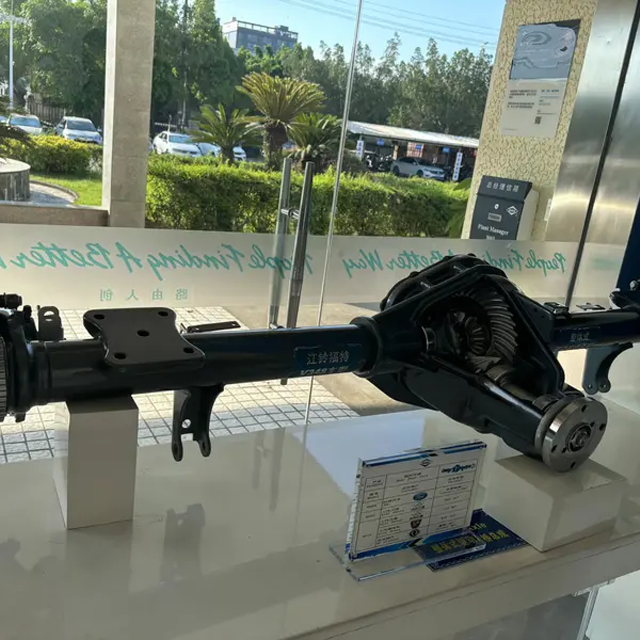
Modern vehicle architectures—particularly SUVs, Light Commercial Vehicles (LCVs), and EVs—face highly conflicting demands. They must significantly increase payload capacity and crash safety. At the same time, engineers are aggressively trying to reduce overall unsprung mass to extend vehicle range. Legacy standard beam tubes often force teams into a difficult structural compromise. You typically must choose between torsional rigidity and weight. This outdated approach leads to either sub-optimal handling dynamics or excessive raw material weight. A precision-engineered Reinforced Auto Rear Beam Tube directly resolves this dilemma. It utilizes advanced metallurgy, variable cross-section forming, and exact tolerance controls. Below, we will explore how upgrading to these reinforced components delivers structural predictability at scale. You will learn to evaluate safety metrics, understand manufacturing precision, and shortlist the right supply partners.
Key Takeaways
Safety & Compliance: Reinforced designs optimize predictable deformation, maximizing crash energy absorption and exceeding stringent industry safety standards.
The Lightweighting Equation: Advanced tube engineering achieves significant weight reduction (lowering unsprung mass) without sacrificing yield strength or load capacity.
Manufacturing Precision: CNC bending and rigorous tolerance controls eliminate micro-fractures and ensure seamless chassis integration on the assembly line.
Strategic Sourcing: Evaluating a tube manufacturer requires auditing their fatigue testing data, custom tooling capabilities, and IATF 16949 compliance.
The Engineering Case for Upgrading to Reinforced Auto Rear Beam Tubes
Automotive chassis design demands absolute reliability under extreme dynamic stress. Standard rear beam tubes frequently reveal severe legacy vulnerabilities during long-term operation. They often suffer fatigue failure when exposed to cyclic torsional stress. High-payload scenarios easily expose their inadequate stiffness. Over time, these standard components develop micro-cracks in high-stress intersection zones. Engineers can no longer rely on uniform-thickness standard piping for advanced suspension systems.
The rise of new vehicle categories accelerates this shift. EVs integrate heavy floor-mounted battery packs. LCVs transport demanding, unpredictable cargo loads. SUVs blend passenger car comfort expectations with off-road capability. These factors necessitate a highly fortified chassis structure. You must manage dynamic weight distribution shifts constantly. Standard tubes simply bend or deform plastically under these intense modern loads.
A Reinforced Auto Rear Beam Tube represents a fundamental engineering upgrade. It is not merely a "stronger" or thicker piece of metal. It functions as a highly predictable structural element. It behaves exactly according to CAD and Finite Element Analysis (FEA) simulations during violent dynamic load shifts.
Consider the primary engineering drivers forcing the transition to reinforced designs:
Unsprung Mass Reduction: Stripping excess weight from the suspension to improve tire traction and ride quality.
Packaging Constraints: Routing complex suspension geometries around EV battery housings tightly.
Lifecycle Durability: Eliminating warranty claims related to suspension sag or rear beam fracture.
Evaluating Safety and Performance Metrics
Material science criteria drive the performance of any modern suspension component. You must evaluate verifiable performance indicators when specifying rear beam tubes. Subjective claims about strength hold no value on the assembly line.
Crash energy absorption remains the most critical safety metric. Reinforced wall thicknesses dictate how the tube handles rear-end collisions. Manufacturers utilize specific High-Strength Low-Alloy (HSLA) or Dual-Phase (DP) steel variants. These alloys control the yield strength meticulously. During a severe impact, the reinforced tube undergoes predictable plastic deformation. It absorbs kinetic energy safely instead of shattering or intruding into the passenger cabin. We rely on this predictable crumple behavior to exceed global safety standards.
Torsion beam suspensions require a delicate mechanical balance. You must balance torsional rigidity against necessary flexibility. Excessive rigidity causes violent body roll over uneven surfaces. It makes the ride intolerably harsh. Conversely, excessive flexibility compromises handling precision during high-speed cornering. A well-engineered Reinforced Auto Rear Beam Tube maintains enough stiffness to prevent chassis twist. Yet, it allows just enough flex to permit independent wheel articulation. This balance keeps both rear tires firmly planted on the tarmac.
Empirical validation proves long-term reliability. Engineers must demand comprehensive durability testing data. Finite Element Analysis (FEA) provides a digital baseline. Multi-axis fatigue testing provides the physical proof. Rigs simulate hundreds of thousands of miles of aggressive driving. They apply continuous cyclic loads. This proves the tube will not suffer premature fatigue failure.
Common Testing Mistakes to Avoid:
Relying solely on static load tests instead of dynamic cyclic testing.
Ignoring corrosion resistance degradation after simulated stress cycles.
Failing to test the specific weld seams where the tube joins the trailing arms.
Performance Comparison Chart
Performance Metric
Legacy Standard Beam Tube
Reinforced Auto Rear Beam Tube
Energy Absorption
Unpredictable crumple zones; risk of cracking.
Controlled deformation; high energy dissipation.
Torsional Balance
Compromised; often too stiff or too weak.
Optimized flex for independent wheel articulation.
Fatigue Life
Prone to micro-fractures under heavy cyclic loads.
Precision Tube Manufacturing: Machining, Bending, and Tolerance Control
Theoretical engineering designs fail if manufacturing execution lacks precision. Implementation realities present significant production risks. Advanced CNC tube bending represents the frontline of chassis manufacturing.
Precision motion control prevents severe structural defects during complex bending operations. Traditional bending methods often cause the metal to fold or stretch unevenly. You risk severe wrinkling on the inner radius. You risk dangerous wall thinning on the outer radius. Furthermore, the tube might suffer ovalization, losing its perfectly round profile. Advanced CNC mandrels and exact hydraulic pressure control prevent these deformities. They ensure the tube retains its intended structural integrity across the tightest bends.
Variable cross-section technology revolutionizes chassis lightweighting. Engineers no longer use standard pipes possessing the exact same thickness from end to end. Instead, advanced forming alters the tube's geometry along its length. It concentrates material thickness specifically where stress concentrations peak. It thins out the metal in non-critical center sections. You put strength exactly where it matters most. This method cuts unnecessary mass dramatically. It helps achieve aggressive lightweighting targets easily.
Weld integrity demands strict microstructural consistency. Welding high-strength steel alters its crystalline structure. This creates a vulnerable Heat-Affected Zone (HAZ). If left untreated, the HAZ becomes a brittle weak point. Advanced manufacturing employs precise post-weld heat treatments. We use automated laser or robotic MIG welding to control heat input meticulously. These processes restore the crystalline structure. They guarantee the tube maintains uniform tensile strength across every millimeter.
Best Practices in Tube Manufacturing:
Implement in-line ultrasonic testing to detect invisible internal weld flaws.
Use automated Coordinate Measuring Machines (CMM) to verify dimensional accuracy.
Apply advanced anti-corrosion e-coatings immediately after the final forming stages.
Application Matrix: Specifying Tubes for SUVs and Light Commercial Vehicles
Different vehicle categories dictate entirely different suspension characteristics. You cannot utilize a one-size-fits-all approach. You must tailor the Reinforced Auto Rear Beam Tube to the specific vehicle platform dynamics.
SUVs feature a notably higher center of gravity than standard sedans. This height amplifies lateral weight transfer during cornering. It creates a severe risk of body roll or even rollover events. SUV dynamics require exceptional anti-roll stability. The reinforced tube must act as a highly tuned torsion bar. It resists the twisting force generated during sharp turns. This keeps the vehicle level. It dramatically improves both passenger comfort and emergency handling limits.
Light Commercial Vehicles (LCVs) operate under entirely different constraints. Payload capacity rules LCV design. Delivery vans and work trucks carry asymmetrical, heavy loads daily. They repeatedly hit their maximum Gross Vehicle Weight (GVW). Reinforced tubes for LCVs prioritize yield strength over subtle ride comfort. They must resist permanent plastic deformation. Even when a fully loaded van hits a deep pothole, the rear beam must spring back to its original shape perfectly.
Platform scalability offers OEMs massive production advantages. Designing a unique suspension for every single car model wastes engineering resources. Standardized yet adaptable reinforced tube designs solve this. OEMs can establish a single baseline chassis architecture. By simply adjusting the wall thickness or altering the CNC bend angles slightly, they can scale the same platform. One baseline architecture serves a compact crossover, a mid-size SUV, and an electric delivery van.
Application Summary Chart
Vehicle Category
Primary Dynamic Challenge
Reinforced Tube Specification Focus
Compact SUVs
High center of gravity; body roll risk.
High anti-roll stability; tuned torsional flexibility.
Procurement Framework: Shortlisting an Automotive Tube Manufacturing Partner
Selecting the right Tier-level supplier determines the success of your chassis program. Procurement managers face immense pressure to secure reliable partners. You must evaluate suppliers strictly on empirical data and certified capabilities.
Quality Management Systems must act as your primary filter. You should view IATF 16949 certification as a non-negotiable baseline. This automotive-specific standard guarantees the supplier utilizes rigorous risk management. It ensures they practice continuous improvement and defect prevention. If a manufacturer lacks this certification, they cannot meet OEM assembly line requirements.
Evaluate their in-house tooling and customization capabilities rigorously. Suspension geometries vary wildly between proprietary OEM designs. Can the supplier rapid-prototype a new design? Do they build custom mandrels and bending dies internally? Suppliers relying entirely on outsourced tooling suffer from sluggish response times. In-house tooling guarantees faster iteration during the crucial R&D phases. It allows engineers to perfect the tube geometry without costly delays.
Supply chain traceability separates elite manufacturers from commodity vendors. You need full metallurgical traceability. The supplier must track every component from the initial raw steel coil procurement. They must document the heat treatment batches. They must record the final dimensional inspection data. If a field failure occurs, you must be able to trace the exact steel batch instantly. This level of transparency protects OEMs from catastrophic, widespread recalls.
Supplier Audit Checklist:
Verify active IATF 16949 certification status.
Request sample multi-axis fatigue testing reports from previous projects.
Inspect their CNC bending equipment age and motion control software.
Confirm their ability to generate automated CMM dimensional reports.
Conclusion
The Reinforced Auto Rear Beam Tube acts as the structural backbone of modern suspension platforms. It solves the critical engineering conflict between maximizing crash safety and aggressively reducing unsprung mass. You cannot treat these components as interchangeable commodity pipes. They require advanced metallurgy, meticulous CNC bending, and zero-defect tolerance control.
When selecting a manufacturing partner, prioritize empirical testing data over basic quotes. Components failing dynamic fatigue tests will halt your assembly lines and trigger costly recalls. Demand transparent traceability and robust in-house tooling capabilities to ensure seamless production integration.
Take proactive steps to secure your supply chain today. Contact your engineering procurement team to review current chassis specifications. Request technical specification sheets and fatigue testing sample data from certified suppliers. Schedule a direct engineering consultation to explore custom variable cross-section applications for your upcoming vehicle platforms.
FAQ
Q: What materials are most commonly used in a Reinforced Auto Rear Beam Tube?
A: Manufacturers primarily utilize High-Strength Low-Alloy (HSLA) steel and Dual-Phase (DP) steel. These advanced alloys provide an optimal balance. They offer excellent formability for complex CNC bending while delivering the exceptionally high tensile strength required for chassis durability.
Q: How does variable cross-section manufacturing reduce vehicle weight?
A: This advanced process alters the tube's thickness along its length. It thickens the walls only at high-stress intersection points to maintain strength. It thins out non-critical areas. This targeted approach cuts unnecessary mass, lowering the vehicle's overall unsprung weight.
Q: What quality control metrics should we require before mass production?
A: You must demand comprehensive validation data. Require dimensional CMM inspection reports to verify geometry. Mandate ultrasonic testing to ensure invisible weld seam integrity. Finally, require cyclic torsional fatigue data to prove long-term lifecycle durability.
Q: Can reinforced rear beam tubes be customized for existing EV platforms?
A: Yes. Advanced CNC bending and in-house custom tooling allow manufacturers to route the tubes precisely. This allows the suspension to clear bulky EV battery housings perfectly without sacrificing the required rear suspension geometry or ride height.